CMHC's new price study looks back, not ahead to your sale.
Before you use a national housing chart to argue for a price, check its dates. A long history can explain a lot without telling you what someone will pay for your house this fall.
Published October 20, CMHC's international comparison follows real house prices from 2005 through 2025. Real means adjusted for inflation. Canada starts at an index value of 100 and ends at 201.02. That's roughly a 101% increase, not a 201% increase.
Notice what happened after the peak
The same table puts Canada's index at 243.59 in 2022, then 220.16 in 2023, 211.96 in 2024 and 201.02 in 2025. Prices can be much higher than they were twenty years ago and lower than they were a few years ago. Both statements can be true.
This is a national, inflation adjusted series. It isn't the dollar value of an individual home, a GTA neighbourhood price estimate or a forecast for 2026.
The starting year changes the conversation
Imagine two people talking about the same home. One bought a long time ago. The other bought much closer to the market peak. They may have very different views of how well that purchase worked out. A chart starting in 2005 doesn't settle either person's position.
For your own move, write down the dates that matter to you. When did you buy? When do you need to sell? Will you also be buying in the same market? Those questions bring the conversation back to your actual decision instead of an impressive national headline.
A supply problem isn't a price guarantee
CMHC links Canada's experience to several forces, including population growth, incomes, borrowing costs and supply that didn't keep pace with demand. It also cautions that differences in countries' data and institutions limit precise comparisons.
Our reading: that is useful background for a housing discussion. It isn't permission to assume that every home will rise in value, or that a buyer must accept any asking price because Canada needs more homes.
If you're buying, ask for recent completed sales that genuinely resemble the property you're considering. If you're selling, compare your home with the choices buyers can see now as well as completed sales. Make the differences in condition, location and property type part of the discussion. Don't try to apply the national index directly to your purchase price.
Keep the history. Use local evidence for the offer.
The study helps explain how Canada got here. A decision about a particular GTA home still needs a current property review, comparable evidence and financing that fits the buyer. A long chart and a specific offer answer different questions.
General information from SirLuckHomes Real Estate Brokerage, not an appraisal or an individual investment recommendation.
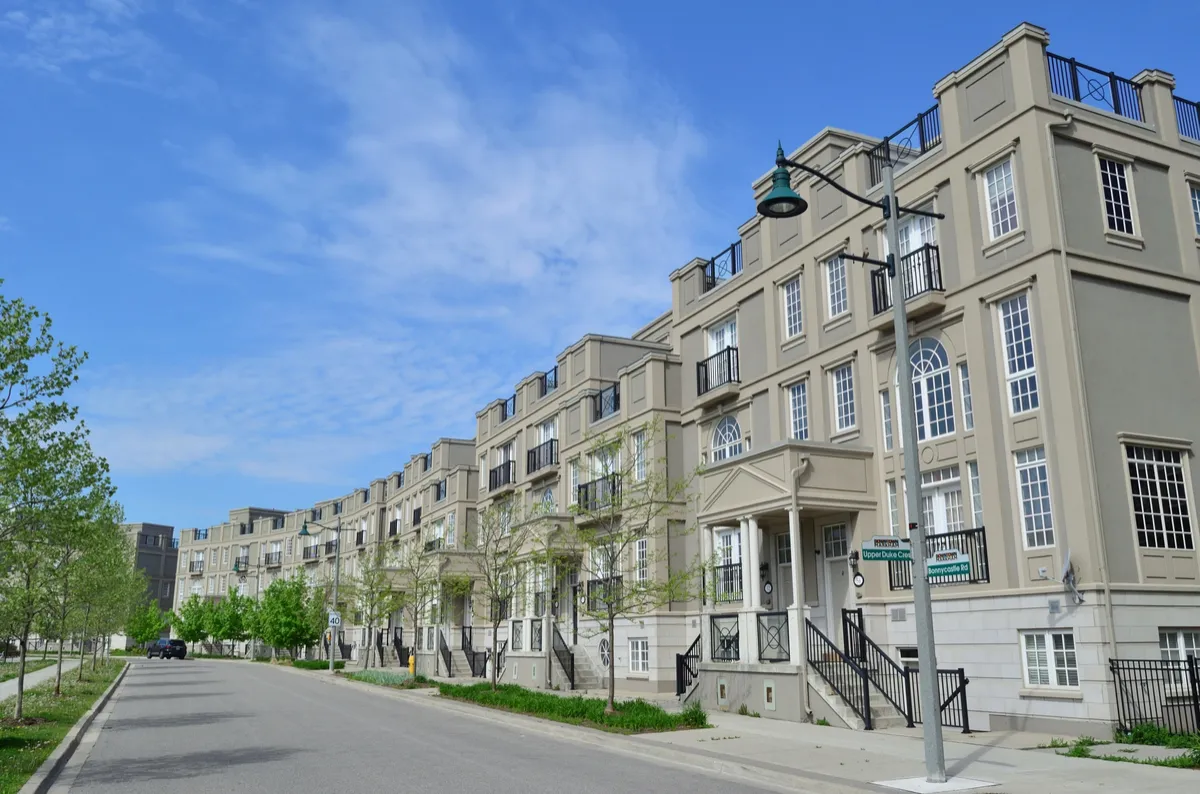
Illustrative photograph of Downtown Markham townhouses, taken May 26, 2020 by Raysonho. Original photograph, released under CC0. These homes are not advertised listings or properties valued by the study.
