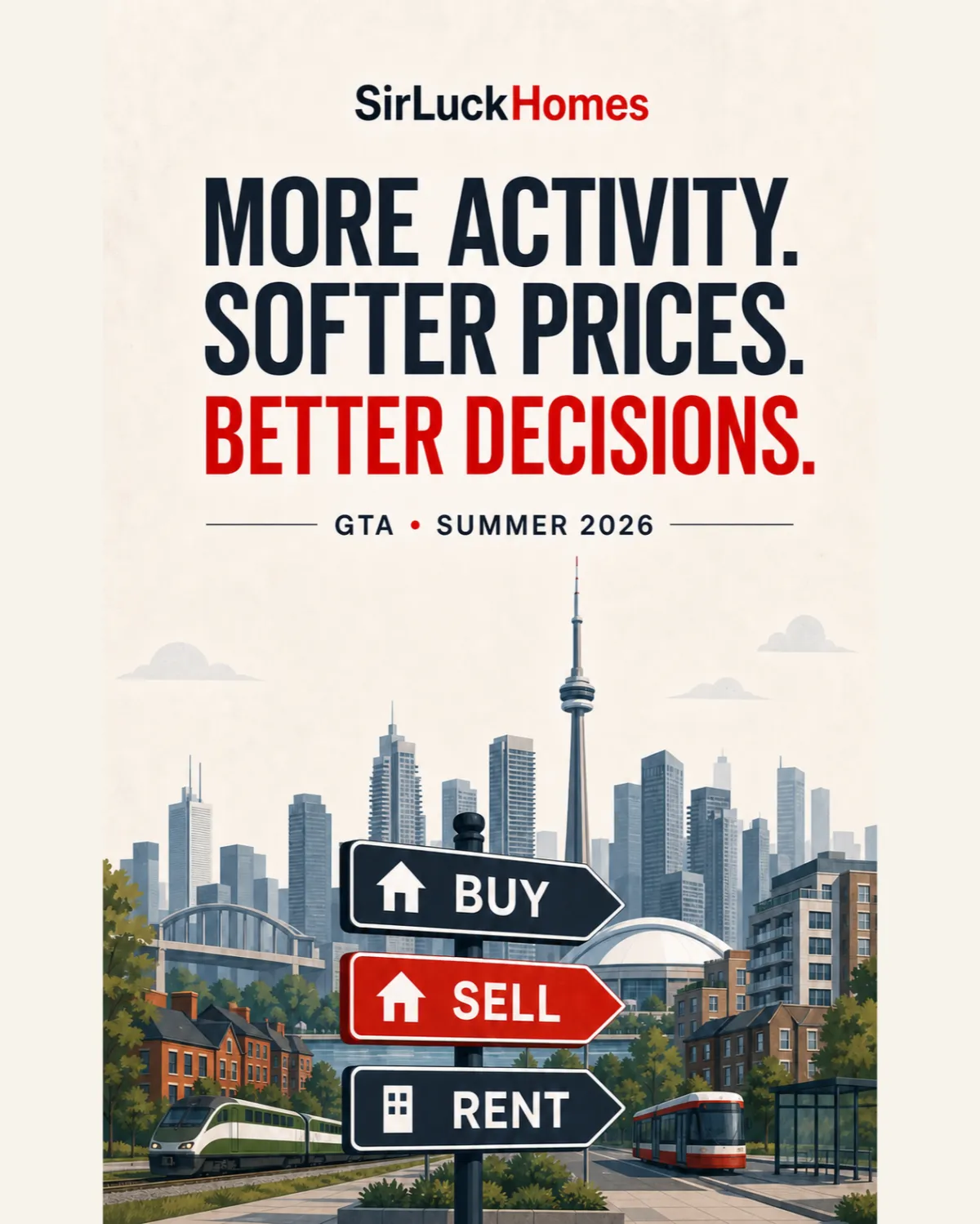
GTA Housing Market Summer 2026: Move or Wait?
The loudest real estate opinions usually arrive in pairs: buy before prices run away or wait because the market is falling. The GTA data is telling a more useful story this summer.
The market is not frozen. It is negotiating.
In June, GTA REALTORS® reported 6,770 sales, up 9.4% from June 2025. At the same time, the average selling price was $1,058,658, down 3.9% year over year, while the MLS® Home Price Index composite benchmark was down 5.4%. In plain language: more people completed moves, but pricing remained softer than a year earlier. That is not a simple boom or crash. It is a selective market where the property, price, financing and terms matter. TRREB June 2026 Market Watch
Nationally, June sales edged up 0.5% from May and activity stood roughly 7% above March. CREA also reported that the national HPI was unchanged month over month and down 3.6% from June 2025. The rebound is real, but uneven. CREA June 2026 statistics
The Bank of Canada held its overnight rate at 2.25% on July 15. That may create a little more planning stability, but it does not mean every mortgage rate will move the same way or that a future cut is guaranteed. The Bank’s next scheduled rate announcement is September 2. Bank of Canada, July 15 decision
CMHC’s summer outlook is cautious. Its Toronto baseline forecast for 2026 anticipates 63,500 MLS® sales, an average price of $1.02 million and a 3.8% vacancy rate. These are forecasts—not promises—and CMHC says uncertainty remains high. The important local signal is that buyers and renters may have more room to compare options today, while historically low Ontario construction—particularly condominiums—could reduce future choice. CMHC Summer 2026 Housing Market Outlook
So what should you do with that information?
If you are buying
Do not buy because someone predicts the next rate move. Get a current pre-approval or rate scenario, set a total monthly-cost ceiling and compare recent sales that truly match the property. A softer headline does not make every home a bargain.
Use the time available to investigate the building, neighbourhood, insurance, taxes, repairs and closing costs. Where appropriate, protect yourself with conditions. RECO’s buyer checklist specifically points to financing and home-inspection conditions as possible protections and warns buyers to think carefully before waiving them. RECO buyer’s checklist
If you are selling
Price against the homes competing with you now—not the best sale you heard about last year. Before launch, agree on what the first 14 days will tell you: showing volume, saves and shares, second visits, buyer objections and any offer activity.
If the response is weak, the answer may be presentation, access, price or the property’s position against alternatives. “The market” is rarely specific enough to be the whole diagnosis.
If you are renting
This is a comparison market in several Toronto-area segments. CMHC reports that Toronto asking rents have been declining amid added supply, and that landlords are using incentives such as discounted parking or move-in credits. The lowest-priced units can still be tight, so negotiate with facts rather than assuming every landlord will discount. CMHC 2026 Mid-Year Rental Market Update
Compare at least three realistic options using the full cost: rent, parking, utilities, insurance, commute and any incentive after it expires. Put every incentive and promise in writing.
If you are a landlord
Compete on total value, not just the asking rent. A clean, well-presented unit, clear application process, responsive communication and sensible inclusion package can matter more than chasing the highest theoretical rent while the unit sits vacant.
For most rent-controlled Ontario tenancies, the 2026 guideline is 2.1%. In most cases at least 12 months must have passed, and the tenant must receive the proper written form at least 90 days before an increase takes effect. Exemptions exist, including certain units first occupied for residential purposes after November 15, 2018, so confirm the rule that applies to the unit. Ontario residential rent increases
The decision is personal; the preparation is measurable
The best summer move may be buying, selling, renting, holding—or doing nothing yet. The useful question is not “What will the entire GTA do?” It is:
What would have to be true for this move to improve my life and finances?
A good plan should be able to answer that with a budget, a timeline, comparable evidence and a fallback. A viral prediction is not a strategy. It is barely a group chat.
Ask SirLuckHomes for a 15-minute Move-or-Wait Review. We will help you define the decision, the evidence you need and the next sensible step—without pretending anyone can predict every rate or price move.
General information only; not legal, tax, mortgage or investment advice. Forecasts are uncertain and neighbourhood conditions vary.